The Franchises That Basically Co-Parented Us: A Millennial Report Card for Gaming's Biggest Names
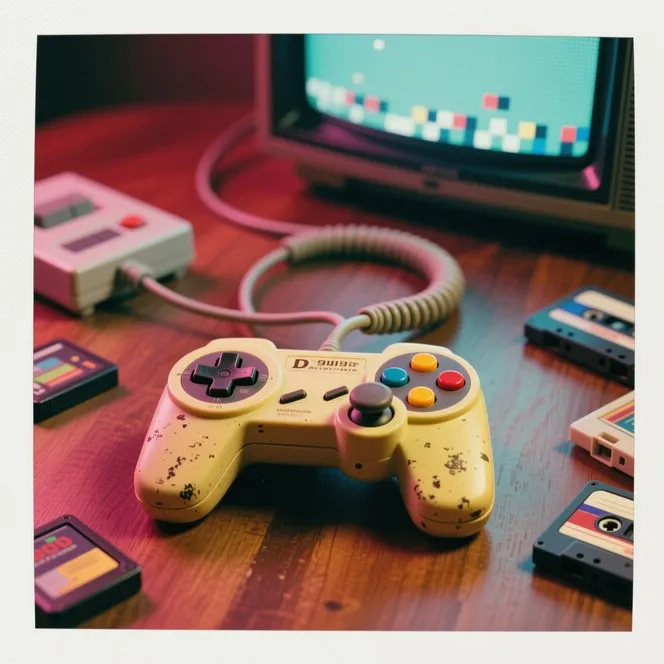
Photo: nostalgic millennial gaming collection retro video games controllers, via images.stockcake.com
There's a particular kind of relationship you have with a franchise that got you through middle school. It's not quite friendship, not quite fandom — it's closer to the complicated bond you have with a hometown you moved away from. You carry it with you. You defend it at parties. And when it disappoints you, it hits different than any other disappointment, because it's not just a game. It's a piece of your actual formation as a human being.
Millennials — loosely defined as the generation born between 1981 and 1996 — grew up in the golden age of gaming franchises. We were the target audience when these properties were being built from scratch, and we've watched them evolve, stumble, sell out, and occasionally reinvent themselves in the decades since. Now we're in our late twenties to early forties, we have real money to spend, and we have opinions. So many opinions.
Consider this a report card. Grades given with love, but grades given honestly.
1. The Legend of Zelda — Grade: A+
Breath of the Wild in 2017 was already proof that Nintendo understood exactly what Zelda meant to the people who grew up with it: freedom, discovery, and the electric feeling of a world that rewards curiosity. Then they went and made Tears of the Kingdom in 2023, which somehow expanded on that promise without losing the soul of it.
Zelda didn't just maintain its legacy. It grew it. Nintendo treated this franchise like the national treasure it is, took creative risks that could have alienated purists, and largely landed every one of them. The millennial who cried at the end of Ocarina of Time in 1998 can cry all over again in 2025, and that's not nothing. That's everything.
What we're owed: Nothing. They paid up. Repeatedly.
2. Pokémon — Grade: C-
Oh, Pokémon. You were our first love. You were the reason we skipped breakfast and hid a Game Boy under our pillow and argued on the playground about whether Charizard was actually a dragon type (he wasn't, and the betrayal was real).
And now look at you. Scarlet and Violet launched in 2022 in a state that would have been embarrassing for a game half its price point. Frame rate drops, clipping issues, performance problems that felt like the technical debt of a franchise being pushed out the door to meet holiday deadlines regardless of readiness. The games improved with patches, but the message was clear: Game Freak knows you'll buy it anyway, so why spend the extra time?
The designs are still charming. The core loop is still addictive. But Pokémon in 2025 feels like a franchise coasting on the loyalty of people who can't quit it no matter how many times it lets them down. Which, admittedly, describes a lot of us.
What we're owed: One mainline Pokémon game built with the budget and timeline it actually deserves. Just one. Please.
3. Halo — Grade: D+
Halo was the franchise that made console gaming feel cinematic. That opening mission of Combat Evolved, the orchestral swell, the Ringworld stretching out in front of you — a generation of kids learned what "epic" meant through Halo. It was the reason millions of us begged our parents for an Xbox. It was the reason we stayed up until 3 AM on school nights and would do it again without hesitation.
Halo Infinite launched in 2021 with a campaign that was genuinely, surprisingly good — and then the wheels fell off. Content droughts. A live-service multiplayer that felt perpetually half-finished. A battle pass system that had the audacity to make players feel nickel-and-dimed in a franchise they'd been loyal to for twenty years. Microsoft's handling of 343 Industries, which culminated in significant layoffs in 2023, felt like watching someone slowly dismantle a monument.
Halo isn't dead. But it's not healthy, and the people who love it most can see the difference between what it is and what it used to be with painful clarity.
What we're owed: A proper next chapter, properly resourced, built by people who love the universe as much as we do.
4. Tony Hawk's Pro Skater — Grade: B+
Nobody expected the comeback, and that's what made it so good. When Tony Hawk's Pro Skater 1+2 dropped in 2020, it felt like running into an old friend who had clearly been working out. The remasters were faithful and fresh simultaneously — tight controls, incredible soundtrack, all the original levels rebuilt with modern polish.
 Photo: Tony Hawk, via images2.alphacoders.com
The franchise even managed to make us forget about Tony Hawk's Pro Skater 5, which is an act of collective memory suppression worthy of its own psychological study. We don't talk about THPS5. We've agreed as a culture to move past it.
The 2023 follow-up plans have moved slower than expected, and the Activision-Microsoft transition created uncertainty. But the goodwill from those remasters is real, and the franchise earned it.
What we're owed: THPS 3+4 remasters. Yesterday, preferably.
5. Final Fantasy — Grade: B
Final Fantasy is complicated in the way that only a franchise spanning decades and wildly divergent creative visions can be complicated. The Final Fantasy VII Remake project has been a genuine triumph — a loving, ambitious, occasionally baffling reimagining that respects the source material while refusing to be imprisoned by it. Final Fantasy XVI was divisive but daring. Final Fantasy XIV, after its disastrous original launch, pulled off one of the greatest redemption arcs in gaming history and has been thriving for years.
Square Enix has made real mistakes — the Stranger of Paradise era of weird spinoffs, the NFT flirtation that nobody asked for — but the core franchise has more creative ambition in 2025 than many of its contemporaries. That counts for something.
What we're owed: FF7 Rebirth Part 3, completed, without another multi-year gap. We have been patient. We have been so patient.
6. Grand Theft Auto — Grade: Incomplete
You can't grade a franchise whose next major installment has been one of the most anticipated releases in entertainment history for years. GTA VI is coming — Rockstar confirmed it, trailers dropped, the internet collectively lost its mind — and everything we've seen suggests it might be the most ambitious open-world game ever made.
But we've been waiting. And GTA Online has spent the intervening years being a microtransaction-laden live-service grind that has occasionally felt more like a second job than a game. The trust is still there, mostly. But Rockstar has been living off GTA V for over a decade, and the bill is due.
What we're owed: Everything GTA VI has promised. Don't make us say we told you so.
7. Crash Bandicoot — Grade: C+
The N. Sane Trilogy remake was excellent. Crash 4: It's About Time was surprisingly ambitious and genuinely hard in ways that felt respectful rather than punishing. And then... quiet. The franchise that once stood as PlayStation's mascot answer to Mario has been sitting in Activision's back pocket, occasionally dusted off for a mobile game or a Kart racer, while its core audience waits for something that feels like a real commitment.
Crash deserves better than being a nostalgia-bait IP managed by committee. He deserves a studio that believes in him the way we believed in him in 1996.
What we're owed: A proper Crash 5 with the same ambition as Crash 4, made by people who care.
8. Mass Effect — Grade: Pending Appeal
The original trilogy is a masterpiece of interactive storytelling. The ending of Mass Effect 3 caused a legitimate cultural controversy — players organized, complained, and pushed back in ways that forced BioWare to release additional ending content. That's how much people cared.
Mass Effect: Andromeda was a stumble. Mass Effect Legendary Edition was a beautifully crafted apology that reminded everyone why they fell in love in the first place. And the next mainline entry has been in development for years with almost no concrete information beyond a teaser trailer.
The verdict on Mass Effect in 2025 depends entirely on what BioWare delivers next. The goodwill is there. The patience is thinning.
What we're owed: Commander Shepard's real legacy, treated with the seriousness it deserves.
9. Sonic the Hedgehog — Grade: B-
Nobody predicted the Sonic rehabilitation arc. After years of genuinely painful releases that became internet memes, Sonic Frontiers arrived in 2022 and was... actually interesting? Flawed, yes. Rough in places. But ambitious in ways the franchise hadn't been in years. Pair that with two legitimately great theatrical films that understood the character better than most of his games did, and Sonic is in the strongest position he's been in since the Sega Genesis era.
Stay the course, Sega. Don't blow it. You know you have a history of blowing it.
What we're owed: Sonic Frontiers 2 that builds on the foundation instead of abandoning it for something unrecognizable.
10. Guitar Hero / Rock Band — Grade: Absent Without Leave
They didn't just raise us. They threw parties for us. They gave us the experience of being in a band without any of the talent requirements, and for a few glorious years in the late 2000s, plastic instrument controllers were the centerpiece of every college apartment and basement hangout in America.
And then they were gone. Oversaturation killed the genre, the plastic peripherals gathered dust, and the licenses lapsed. Rock Band 4 exists, technically, but the cultural moment has long passed.
The tragedy of Guitar Hero and Rock Band isn't that they failed. It's that they succeeded so completely, so brilliantly, and then the industry panicked and flooded the market until everyone was sick of them. We didn't fall out of love. We were pushed.
What we're owed: A proper revival. The audience is still here. We never actually left.
This is what it means to grow up with a franchise: you carry it with you, you measure it against what it meant to you at ten years old, and you hold it to a standard that's equal parts fair and completely unreasonable. Because that's what love does. Even the pixelated kind.