Financing Your Twitch Dreams: Inside the College Gaming Setup Gold Rush That's Bleeding Students Dry
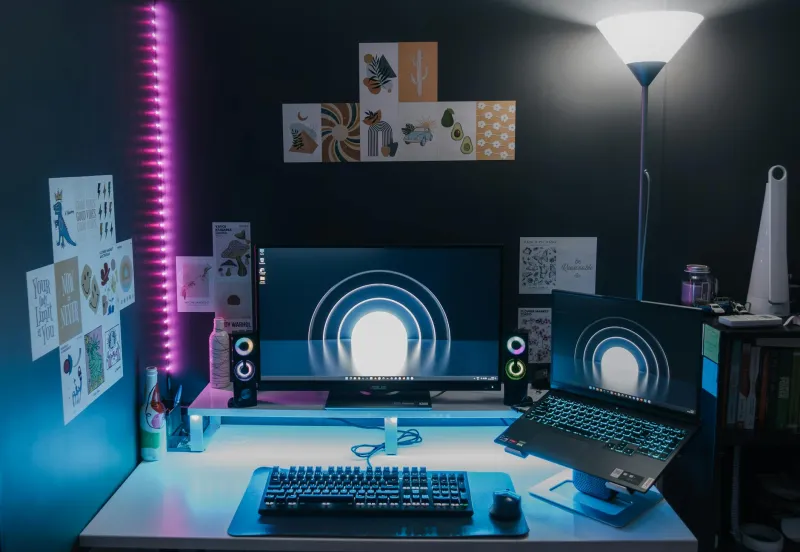
The $5,000 Dorm Room Dream
Walk through any college dorm these days, and you'll spot them immediately: the glowing RGB shrines that cost more than most students' cars. Gaming setups that would make professional streamers jealous, financed by kids who've never filed a tax return.
Meet Tyler, a sophomore at Ohio State who spent $4,200 on his "content creation station" — a custom-built PC, dual monitors, professional lighting, and a microphone that costs more than textbooks for an entire semester. How'd he afford it? A combination of student loan money, a Best Buy credit card, and weekend shifts at Target that barely cover the minimum payments.
 Photo: Ohio State, via www.buckeyesports.com
"Everyone says you need to invest in yourself," Tyler explains, adjusting his $300 gaming chair. "If I'm gonna make it as a streamer, I need gear that looks professional. You can't compete with a laptop webcam anymore."
Tyler has 47 followers on Twitch and hasn't made a dollar from streaming. But he's not alone — he's part of a massive cultural shift where college students are treating gaming equipment like business investments, even when the business doesn't exist yet.
The Influencer Pipeline: How Brands Turned Students Into Walking Advertisements
The companies selling this equipment aren't targeting college students by accident. They've built an entire marketing ecosystem designed to make 19-year-olds feel like they're one purchase away from internet fame.
It starts with sponsored content from mid-tier streamers — creators with 50K-200K followers who feel "attainable" to college viewers. These streamers casually mention their setups, drop affiliate links, and make it seem like success is just a matter of having the right gear. The message is subtle but clear: this equipment isn't an expense, it's an investment.
"We definitely see higher conversion rates among the 18-22 demographic," admits a marketing executive at a major gaming peripheral company, speaking on condition of anonymity. "They're more willing to stretch their budgets for aspirational purchases. It's not just about the product — it's about the lifestyle they think it represents."
The numbers back this up. Industry data shows that college-aged consumers are 40% more likely to finance gaming equipment purchases compared to other age groups. They're also twice as likely to buy premium versions of products they could get for half the price.
The Payment Plan Paradise: Why Everything Costs "Only" $30 a Month
Here's where it gets really clever. Almost every major gaming retailer now offers payment plans that break expensive purchases into bite-sized monthly chunks. That $1,500 graphics card? Just $125 a month for 12 months. The $800 streaming setup? Only $67 monthly.
These plans prey on a fundamental misunderstanding of money that's especially common among college students. When you're already living paycheck to paycheck on dining hall credits and part-time wages, $30 a month feels manageable. $360 upfront feels impossible.
But here's the math they don't advertise: most of these payment plans come with interest rates between 15-30% APR. That $1,500 graphics card ends up costing $1,800-2,000 by the time you're done paying. The companies make more profit from the financing than the actual hardware.
Student Loans: The Ultimate Gaming Credit Card
The most troubling trend? Students using financial aid money to fund their creator dreams. Federal student aid is supposed to cover education-related expenses, but the definition of "education-related" has gotten pretty flexible.
A computer for schoolwork? Absolutely covered. The fact that this computer happens to have a $500 graphics card for "multimedia coursework" and RGB lighting for "productivity"? Well, that's between you and your future self who'll be paying off those loans.
"I justified it as a computer for my digital media classes," says Sarah, a junior at UC Berkeley who spent $2,800 in student loan money on a streaming setup. "But honestly, I use it 90% for gaming and streaming attempts. I know it's not technically what the money was for, but everyone does it."
 Photo: UC Berkeley, via sfyimby.com
Financial aid offices are catching on. Some schools now explicitly prohibit using aid money for gaming equipment, but enforcement is nearly impossible. How do you prove that RGB keyboard isn't for "graphic design coursework"?
The Creator Economy's Dirty Secret: Most Creators Don't Make Money
Here's what the marketing doesn't tell you: 95% of people trying to make money from gaming content never earn enough to cover their equipment costs. The creator economy is a pyramid scheme disguised as a meritocracy, where the people selling shovels (gaming companies) make more money than the people digging for gold (aspiring streamers).
Platform data shows that the average Twitch streamer earns less than $200 per year. YouTube gaming creators fare slightly better, but 80% never reach the $100 minimum payout threshold. Meanwhile, these same creators often spend thousands annually on equipment, software, and promotional activities.
The companies selling gaming gear know these statistics. They also know that hope sells better than reality, so they focus their marketing on the 1% of creators who actually make it big, not the 99% who end up with expensive hobbies and mounting debt.
The Real Winners: Everyone Except the Students
While college students max out credit cards chasing streaming dreams, the companies enabling this behavior are posting record profits. Gaming peripheral sales to the 18-24 demographic have increased 340% since 2020, driven largely by financing options and influencer marketing.
Credit card companies are also cashing in. Gaming equipment purchases are among the fastest-growing categories for student credit card debt, with average balances increasing 65% year-over-year among college-aged cardholders.
Even the colleges benefit indirectly. Students spending financial aid money on gaming equipment often need to take out additional private loans to cover actual educational expenses, generating more fee revenue for institutions.
The Graduation Day Reality Check
Fast-forward four years, and the math gets brutal. The average college student pursuing gaming content creation graduates with $15,000-25,000 in equipment-related debt on top of their student loans. Most have never earned enough from content creation to justify a single purchase, let alone their entire setup.
"I spent more on streaming equipment in college than I made from streaming in the five years since graduation," admits Marcus, now 27 and working in accounting. "I kept thinking the next upgrade would be the one that made me blow up. Looking back, I was basically gambling with money I didn't have."
Breaking the Cycle: Gaming on a Budget That Won't Ruin Your Future
The solution isn't to avoid gaming entirely — it's to separate the hobby from the hustle. You can create content with equipment that costs hundreds, not thousands. The difference in quality is marginal, but the difference in financial stress is massive.
More importantly, treat content creation like any other business venture: don't invest money you can't afford to lose, and definitely don't borrow money to fund a venture with a 95% failure rate.
The gaming industry wants college students to believe that success is just one purchase away. But the only guaranteed winner in that equation is the company selling the equipment. Your future self will thank you for remembering that.